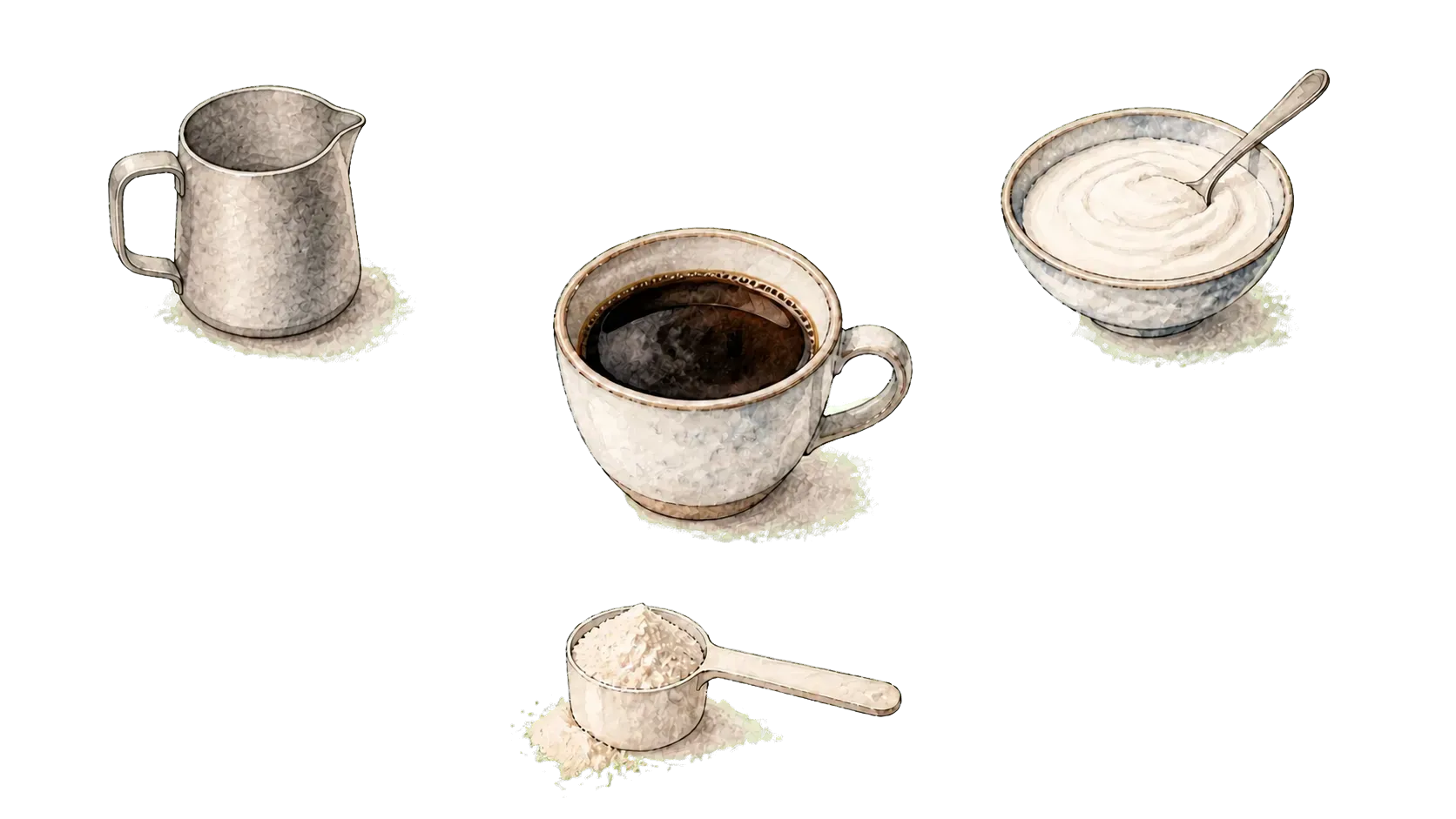
If you want more protein in a coffee you already drink, coffee itself is not the source. In every recipe here, the meaningful amount comes from milk, yogurt, or protein powder. What matters is what went into the cup, and how much.
The estimates below use ingredient mass and representative entries from the USDA FoodData Central datasets. They are reference calculations, not guarantees for every carton, cafe, or scoop. Declared quantities matter more than a drink’s name.
Seven classic drinks, measured the same way
Black coffee stays below 0.1 g of protein at the serving sizes used here. The progression from macchiato to latte is therefore mostly a progression in milk mass. These are declared reference recipes rather than universal definitions. Cafe recipes vary, and milk foam changes volume much more than it changes the ingredient mass. One useful anchor is the Istituto Espresso Italiano specification, which uses 25 ml espresso and 100 ml steamed milk for its certified cappuccino.
Protein coffee explorer
Compare declared recipes, then calculate with the ingredients in your kitchen.
Reference recipes use ingredient mass and representative USDA entries. Cafe sizes and products vary.
Every strip fills the same width. Its segments show each ingredient's share by mass, not the final drink size. Hover or focus a segment for its amount and share.
- Espresso
- Milk
- Water
Espresso
36 g espresso
<0.1 g3 kcal
Americano
36 g espresso plus 180 g water
<0.1 g3 kcal
Macchiato
36 g espresso plus 15 g whole milk
0.5 g12 kcal
Cortado
36 g espresso plus 60 g whole milk
2.0 g39 kcal
Cappuccino
25 g espresso plus 100 g whole milk
3.3 g62 kcal
Flat white
36 g espresso plus 120 g whole milk
4.0 g75 kcal
Latte
36 g espresso plus 220 g whole milk
7.2 g135 kcal
Read the comparison as a table
| Drink | Reference recipe | Protein | Energy |
|---|---|---|---|
| Espresso | 36 g espresso | <0.1 g | 3 kcal |
| Americano | 36 g espresso plus 180 g water | <0.1 g | 3 kcal |
| Macchiato | 36 g espresso plus 15 g whole milk | 0.5 g | 12 kcal |
| Cortado | 36 g espresso plus 60 g whole milk | 2.0 g | 39 kcal |
| Cappuccino | 25 g espresso plus 100 g whole milk | 3.3 g | 62 kcal |
| Flat white | 36 g espresso plus 120 g whole milk | 4.0 g | 75 kcal |
| Latte | 36 g espresso plus 220 g whole milk | 7.2 g | 135 kcal |
Four ways without protein powder
The least disruptive way to add protein to coffee is to choose a milk-forward recipe. The representative nonfat and soy milks used here contain slightly more protein per 100 g than the whole-milk entry. Greek yogurt takes the drink in a different direction entirely: cold, thick, and tangy. The iced recipe below uses hot-brewed coffee that is chilled; the cold brew vs iced coffee guide explains why that is not automatically cold brew.
Representative unsweetened oat and almond milks contain less protein than the dairy and soy entries used here. That is a comparison between specific database foods, not a rule for every carton.
Whole-milk latte
Measured ingredients
- 36 g espresso
- 240 g whole milk
Make it: Steam the milk to the texture you like, then pour it into the espresso. A larger milk share makes a milder coffee, not a stronger black coffee.
Ingredient share by mass
Estimate uses representative USDA whole milk and espresso. Sweeteners are not included.
Unsweetened soy latte
Measured ingredients
- 36 g espresso
- 240 g unsweetened soy milk
Make it: Warm the soy milk gently. If your carton tends to split in acidic coffee, pour the espresso into the milk gradually instead of all at once.
Ingredient share by mass
Estimate uses the representative USDA unsweetened soy entry. Actual cartons vary.
Nonfat-milk latte
Measured ingredients
- 36 g espresso
- 240 g nonfat milk
Make it: Steam the milk, then pour it into the espresso. Nonfat milk usually produces a lighter body and a drier foam than whole milk.
Ingredient share by mass
Estimate uses representative USDA nonfat milk and espresso. Sweeteners are not included.
Greek-yogurt iced coffee
Measured ingredients
- 150 g plain whole-milk Greek yogurt
- 100 g whole milk
- 100 g brewed coffee, chilled
- 80 g ice
Make it: Blend the cold yogurt and milk until smooth. Add the chilled coffee and ice, then blend again.
Ingredient share by mass
Estimate uses representative USDA whole-milk Greek yogurt, whole milk, and brewed coffee. Ice and optional sweetener are excluded.
Two recipes with protein powder
For both recipes, the estimate assumes 25 g protein powder contributing 20 g protein and 100 kcal. This is a calculation assumption, not a universal scoop size. The explorer lets you replace the protein and energy numbers with a different protein powder estimate.
Hot protein latte
Measured ingredients
- 36 g espresso
- 150 g whole milk, divided
- 25 g protein powder contributing 20 g protein and 100 kcal
Make it: Stir the protein powder into 50 g cool milk until smooth. Warm the remaining 100 g milk and add it gradually to the paste. Pour in the espresso last. Cocoa, cinnamon, or vanilla can be added to taste but are not included in the estimate.
Ingredient share by mass
Estimate includes the declared 25 g protein powder portion with 20 g protein and 100 kcal. Optional flavorings are excluded.
Iced soy protein coffee
Measured ingredients
- 150 g brewed coffee, chilled
- 200 g unsweetened soy milk
- 25 g protein powder contributing 20 g protein and 100 kcal
- 100 g ice
Make it: Add the cold coffee and soy milk to a shaker or blender before adding protein powder. Mix, then serve over the ice. Grittiness depends on the protein powder formula.
Ingredient share by mass
Estimate includes the declared 25 g protein powder portion with 20 g protein and 100 kcal. Ice and optional flavorings are excluded.
Mix cool first to avoid clumps
Starting with a cool paste is a practical way to remove dry pockets before warm milk and coffee enter the cup.
- Start coolReserve a little milk or use chilled liquid.
- Add protein powderMeasure the portion used in the recipe.
- Make a pasteStir until no dry pockets remain.
- Warm graduallyAdd warm liquid in small additions.
- Add coffeeFinish with espresso or brewed coffee.